


Page 36 - ROTAMIZ BİLİM- ARAKLI MERKEZ İLKOKULU
P. 36
ARTIFICIAL INTELLIGENCE: PAST, PRESENT, AND FUTURE


                 Origins and Historical Development
                 The theoretical foundations of artificial intelligence were laid in the 1950s when mathematician
                 and computer scientist Alan Turing posed the question, “Can machines think?” The Dartmouth
                 Conference held in 1956 is widely regarded
                 as the official starting point of artificial
                 intelligence as a distinct field of research.
                 During this early period, AI was primarily
                 addressed within the framework of
                 symbolic logic, rule-based systems, and
                 theoretical discussions.


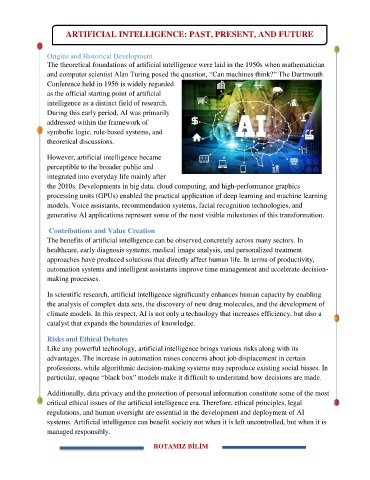
                 However, artificial intelligence became
                 perceptible to the broader public and
                 integrated into everyday life mainly after
                 the 2010s. Developments in big data, cloud computing, and high-performance graphics
                 processing units (GPUs) enabled the practical application of deep learning and machine learning
                 models. Voice assistants, recommendation systems, facial recognition technologies, and
                 generative AI applications represent some of the most visible milestones of this transformation.

                  Contributions and Value Creation
                 The benefits of artificial intelligence can be observed concretely across many sectors. In
                 healthcare, early diagnosis systems, medical image analysis, and personalized treatment
                 approaches have produced solutions that directly affect human life. In terms of productivity,
                 automation systems and intelligent assistants improve time management and accelerate decision-
                 making processes.

                 In scientific research, artificial intelligence significantly enhances human capacity by enabling
                 the analysis of complex data sets, the discovery of new drug molecules, and the development of
                 climate models. In this respect, AI is not only a technology that increases efficiency, but also a
                 catalyst that expands the boundaries of knowledge.

                 Risks and Ethical Debates
                 Like any powerful technology, artificial intelligence brings various risks along with its
                 advantages. The increase in automation raises concerns about job displacement in certain
                 professions, while algorithmic decision-making systems may reproduce existing social biases. In
                 particular, opaque “black box” models make it difficult to understand how decisions are made.

                 Additionally, data privacy and the protection of personal information constitute some of the most
                 critical ethical issues of the artificial intelligence era. Therefore, ethical principles, legal
                 regulations, and human oversight are essential in the development and deployment of AI
                 systems. Artificial intelligence can benefit society not when it is left uncontrolled, but when it is
                 managed responsibly.

                                                        ROTAMIZ BİLİM

